Understanding Hip Pain, Load, Movement, and Assisted Stretching
Why Does Your Hip Hurt? The Real Cause May Be Deeper Than a Tight Muscle
Hip pain can be frustrating because it affects so much of everyday life. You may notice it when walking up stairs, getting out of a car, sitting at a desk, squatting at the gym, running, cycling, sleeping on one side, or simply taking a longer walk than usual.
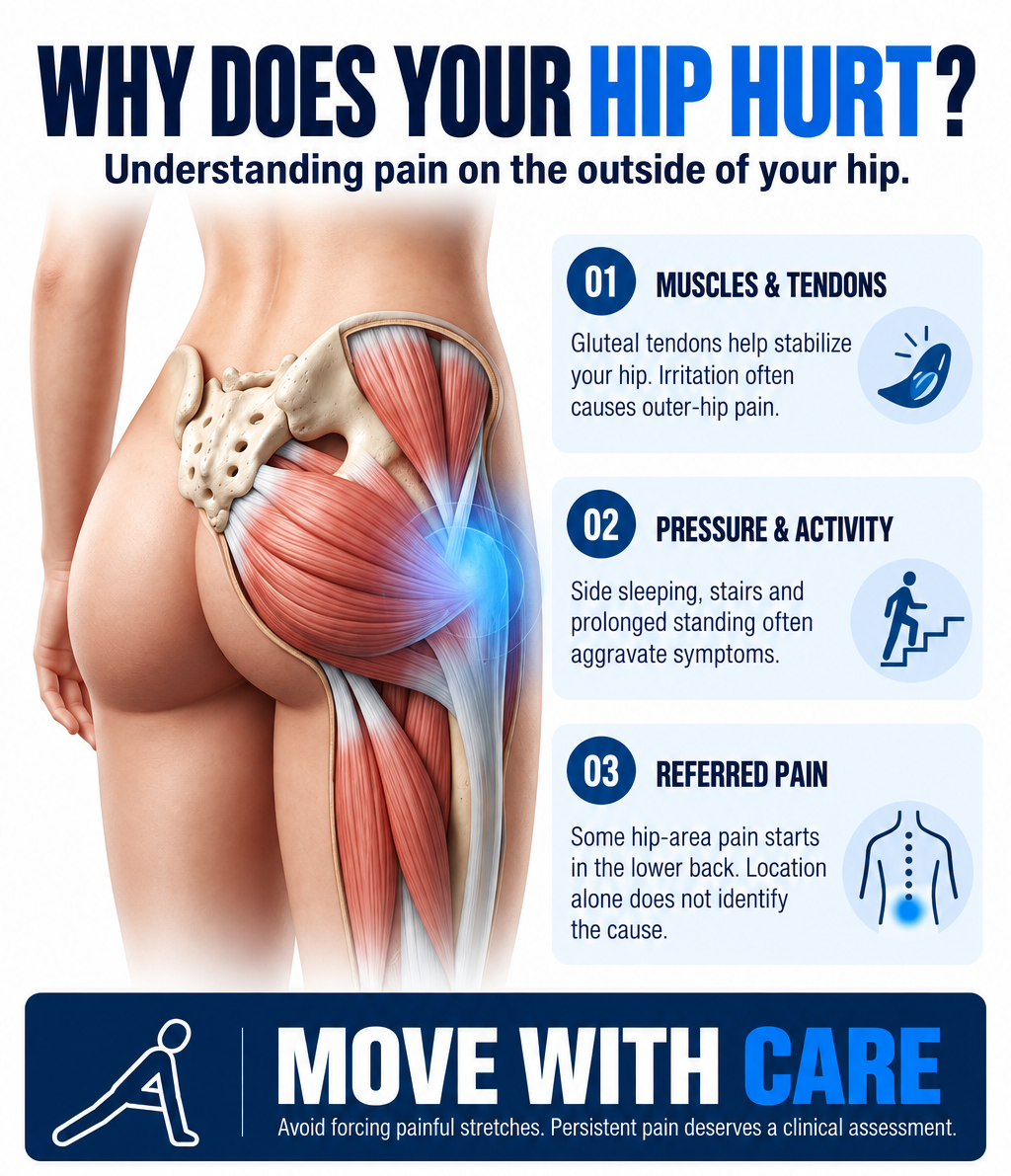
The hip is one of the body’s most important movement and load-transfer systems. It connects the trunk and pelvis to the leg, helping you create, absorb, and control force every time you walk, run, jump, climb, lunge, squat, or change direction. Because so many tissues work together in a relatively small area, pain near the hip may involve more than one factor.
The place where you feel pain is not always the exact location or cause of the problem.
That is why a smarter approach to hip discomfort begins with understanding the entire system—not just chasing the painful spot with aggressive stretching, foam rolling, or random exercises.
For many people, the first thought is simple: My hip must be tight. I just need to stretch it.
Sometimes mobility work can be helpful. But hip discomfort is not always that simple.
At Utah Stretch, assisted stretching can be a valuable part of a personalized mobility routine. The goal is not to force your body into painful positions. It is to help you move more comfortably, improve usable range of motion, reduce the feeling of stiffness, and support the movement habits that help your hips function well over time.
Your Hip Is a Load-Transfer System
It helps to think of the hip as a biological engineering system. Your pelvis acts as a central platform. Your femur, or thigh bone, works as a long lever. The gluteal muscles generate and control force. Tendons connect those muscles to bone. Fascia helps distribute tension across connected areas of the body. The surrounding joints, muscles, connective tissues, and nervous system all communicate during movement. Every step creates a coordinated sequence of compression, tension, rotation, and shear. For example, during single-leg activities—such as walking, running, climbing stairs, or stepping off a curb—one hip must support and stabilize much of your body weight while the other leg moves forward. Your glutes, trunk, pelvis, and leg all have to work together to keep movement controlled.
When that system is repeatedly exposed to more stress than it can comfortably tolerate, discomfort can develop. That does not automatically mean one muscle is weak. It also does not mean poor posture is always to blame. Hip pain is usually more complex than a single “bad” body part or a single movement mistake. Instead, it may reflect a mismatch between the loads your body is experiencing and the capacity it currently has to tolerate those loads.
Why Hip Pain Can Feel Confusing
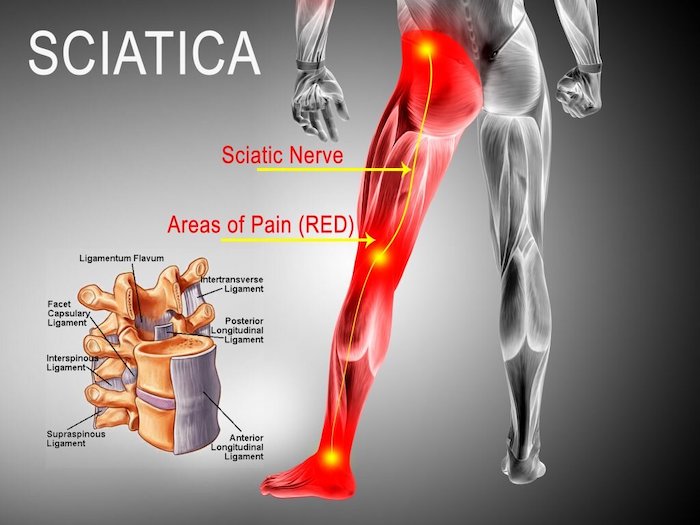
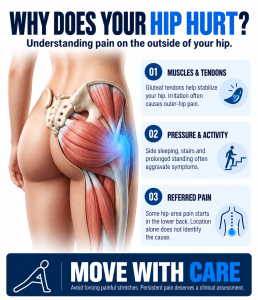
A person may feel hip pain in the front of the hip, on the outside near the bony prominence, deep in the groin, around the glute area, or even down the thigh. Those locations can provide useful clues, but they are not a diagnosis by themselves.
Pain around the hip can involve muscles, tendons, bursae, joints, nerves, connective tissue, or structures that refer discomfort into a broader region. This is why self-diagnosing based only on a painful spot can be misleading.
Someone with pain on the side of the hip may assume that the issue is simply a “tight IT band.” Another person may feel discomfort in the front of the hip and conclude that the hip flexors need to be stretched harder.
Yet the real pattern may involve training load, limited recovery, repeated compression, changes in movement strategy, or irritation in a deeper structure.
The important question is not only, “Where does it hurt?”
A more useful question is, what movements, positions, and loads tend to bring on the symptoms?
That question shifts your attention from chasing pain to understanding patterns.
Common Reasons Your Hip May Hurt
Hip discomfort can develop for many reasons. Here are several common mechanical contributors.
Repeated Compression: Certain positions can repeatedly compress sensitive tissues around the hip.
This can happen when lying on one side, crossing the legs, standing with one hip dropped out to the side, or repeatedly moving into positions that compress the outer hip.
If a structure is irritated by compression, pushing harder into stretches may not be the best first move. More range of motion is not automatically better when that range consistently reproduces pain.
Sudden Increases in Activity
A major jump in running mileage, cycling volume, squat training, hill work, jumping, hiking, or sports participation can overwhelm the body’s current capacity.
This is often called a load spike.
The activity itself may not be “bad,” but the increase may have happened faster than your tissues could adapt.For example, someone who normally runs a few miles twice a week may feel fine.
But adding several longer runs, more speed work, and a weekend hike within the same week can create a dramatic increase in demand on the hips, tendons, and muscles.
Repetitive Movement Patterns
Your body needs movement, but repeating the same movement thousands of times puts stress on the same tissues over and over again.Cyclists may be in a flexed hip position for extended periods. Runners can continue to use the same stride pattern for miles. Desk workers can sit all day long.
And lifters may train similar squat, hinge, or lunge patterns without sufficient recovery or variation in movement. None of these activities are automatically harmful.
The question is, does your body have enough capacity and recovery and movement variety to handle the total demand?
Reduced Hip Mobility
Mobility is not just flexibility. Flexibility describes the available length or range of a tissue, while mobility is the ability to actively control movement through that range.
When hip motion feels restricted, other areas may compensate. The lower back, pelvis, knees, or feet may take on additional movement demands. Over time, that compensation can make certain activities feel less efficient or more uncomfortable.
This is one reason assisted stretching can be helpful. A guided session can address movement quality and range of motion in a controlled way, rather than relying on a quick, one-size-fits-all stretch.
Tendon Overload
Tendons transfer force from muscle to bone. They respond to mechanical loading, which means they can become stronger and more resilient over time. But tendon adaptation depends on the right relationship between load and recovery.
Too little loading may reduce capacity. Too much loading too quickly may create sensitivity. The answer is often not complete rest forever or immediate return to full-intensity training. It is usually a gradual, sensible progression.
Movement Compensation
When movement hurts, the body naturally tries to protect itself. You may shift your weight, shorten your stride, avoid loading one leg, rotate differently, or change your squat pattern without realizing it.
These compensations can be useful in the short term because they help you get through the day. But if they become habitual, they may shift extra demand into the low back, opposite hip, knee, or ankle.
How Assisted Stretching Can Help Your Hips
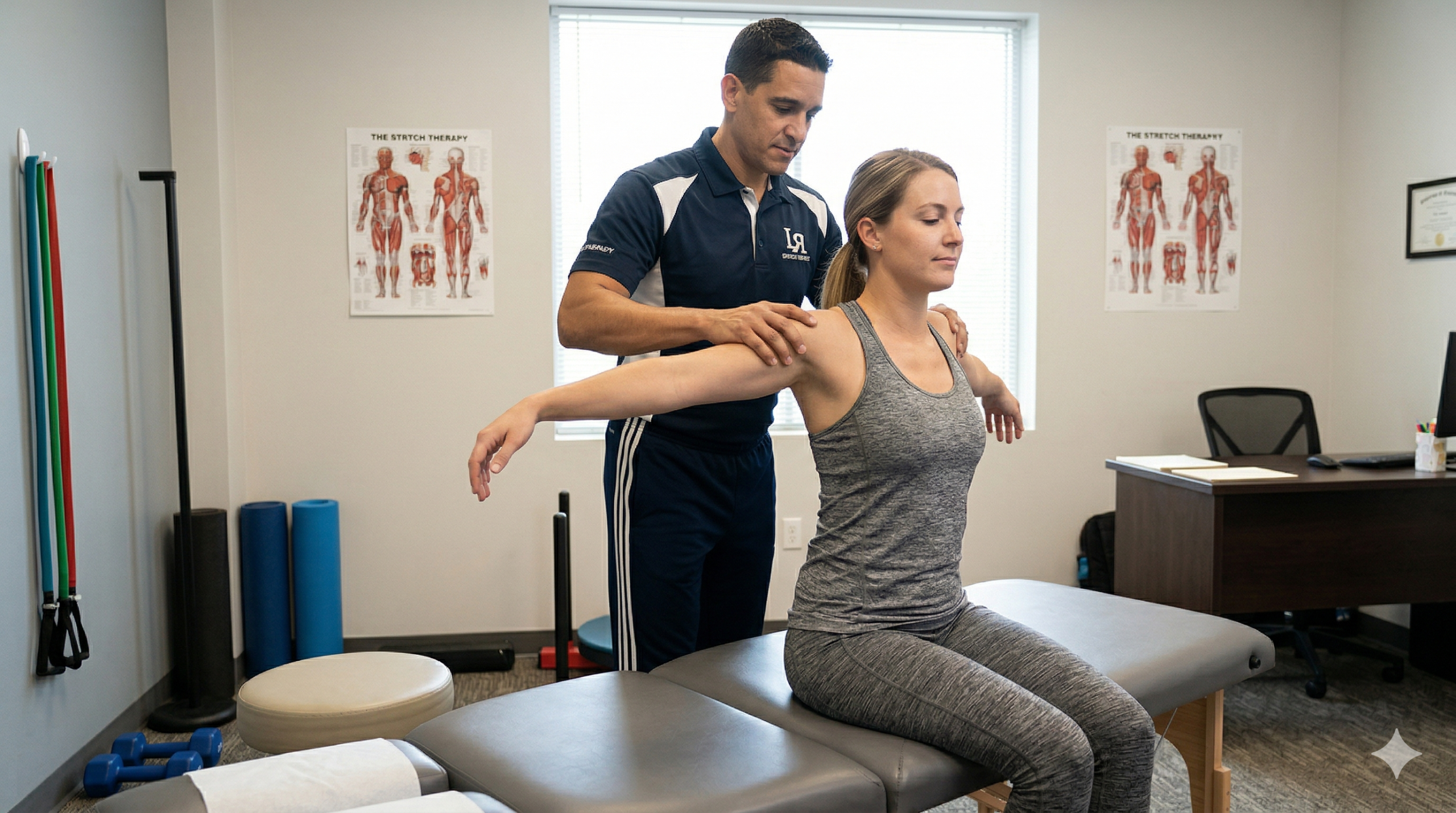
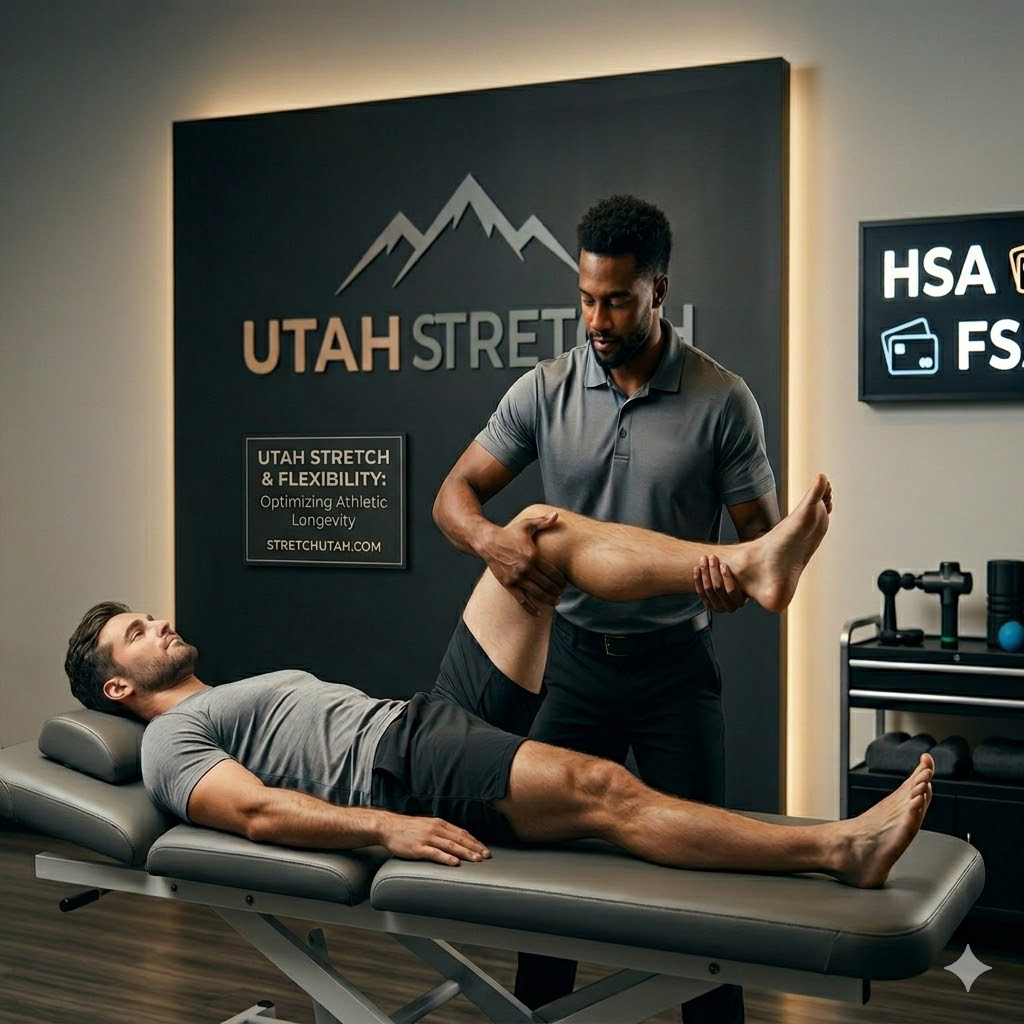
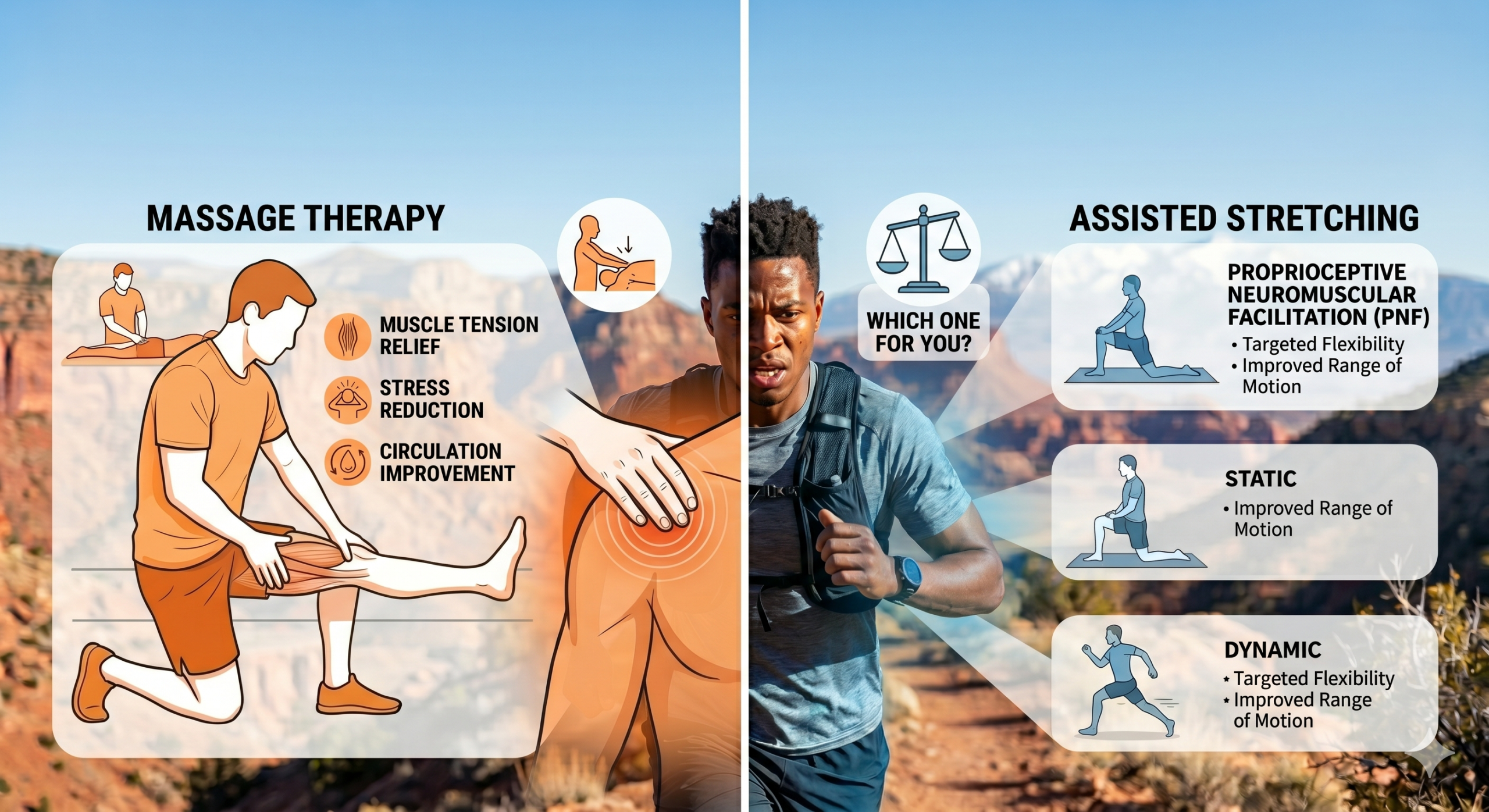
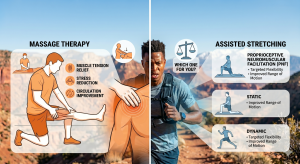
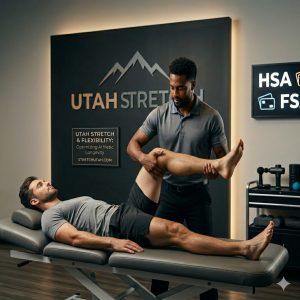
Assisted stretching provides a guided form of mobility work in which a trained stretch practitioner helps move your body through controlled ranges of motion. Instead of trying to force a stretch alone, you can receive support with positioning, relaxation, breathing, and gradual movement.
At Utah Stretch, assisted stretching can help clients who feel stiff from long workdays, repetitive training, cycling, strength workouts, running, travel, or general daily activity. Sessions can support hip mobility by addressing not only the immediate hip area but also connected regions such as the glutes, hamstrings, hip flexors, quads, lower back, and legs.
• Potential benefits of assisted stretching for hip mobility include:
• Supporting a more comfortable range of motion in the hips.
• Helping reduce the common feeling of tightness after sitting, training, or traveling.
• Improving awareness of how your hips, pelvis, and legs move together.
• Encouraging relaxation and controlled breathing during mobility work.
• Complementing strength training, recovery routines, and active lifestyles.
• Giving you a consistent mobility practice when self-stretching is difficult to prioritize.
Assisted stretching is especially useful for people who know they “should stretch” but struggle to make it consistent. A scheduled session creates time to focus on your body without having to design an entire mobility routine alone.
It is important to set realistic expectations. Assisted stretching is not a medical diagnosis, physical therapy, or a substitute for evaluation of a serious injury. However, for many people, it can be a practical wellness service that supports better movement, recovery, and body awareness.
Move Better With Utah Stretch
Your hip is not just a ball-and-socket joint. It is a dynamic connection point between your trunk, pelvis, and lower body—and it has to handle a tremendous amount of work every day.
When your hips feel tight, sore, or restricted, the answer may not be to push harder into a stretch. A better starting point is to understand the pattern, manage the load, and choose movement strategies that support your specific needs.
Utah Stretch offers assisted stretching designed to help you improve mobility, recover from the demands of work and training, and feel more connected to how your body moves. Whether you are active in the gym, on the bike, on the trail, at a desk, or simply want to move with more freedom, consistent assisted stretching can be a valuable part of your wellness routine.
Ready to give your hips more attention? Schedule an assisted stretching session with Utah Stretch and discover what more comfortable, intentional movement can feel like.